





































Cutting clean and accurate circles in wood is a common task in woodworking, home improvement projects, furniture making, and creative crafts. Whether you're producing wall clocks, coasters, speaker cut-outs, signage, or decorative panels, the method you choose directly affects precision, finish quality, and overall efficiency.
Some approaches are straightforward and beginner-friendly, while others require specialised equipment and greater technical control.
In this guide, you'll discover eight reliable methods for cutting circles in wood — ranging from traditional hand tools to advanced laser cutting systems. Each technique offers distinct advantages, helping you select the most suitable option based on your tools, project scope, and skill level.

In this article:
- Part 1: Eight methods to cut a circle in wood
- Method 1: Laser cutting
- Method 2: CNC router
- Method 3: Router + circle jig
- Method 4: Hole saw
- Method 5: Jigsaw
- Method 6: Band saw
- Method 7: Scroll saw
- Method 8: Lathe turning
- Part 2: Why laser cutting is the most recommended method
- Part 3: How to cut a circle in wood with LX2
- Part 4: FAQs about cutting a circle in wood
Part 1: Eight methods to cut a circle in wood
Before looking at each method in detail, it's helpful to understand how they differ. The key factors include cutting accuracy, ease of use, cost of equipment, and suitability for different project types and skill levels.
Method 1: Laser cutting
Laser cutting is one of the most precise and modern ways to cut perfectly round circles in wood. The beam follows a digital design file exactly, making it ideal for highly accurate work.
With a laser cutter, you can produce small jewellery-sized discs or larger decorative panels with the same consistency. Because there is no physical blade contact, vibration is minimal and edges are typically clean and smooth.
Method 2: CNC Router
A CNC router cuts circles by following a programmed toolpath. It delivers excellent precision and handles thick hardwood effectively.
However, it requires knowledge of toolpath programming, bit selection, and speed settings. CNC routers are well suited to professional workshops producing repeated or large-scale components.
Method 3: Router + circle jig
Pairing a handheld router with a circle jig offers a reliable way to cut larger circles with good precision. The jig keeps the rotation consistent while the router bit creates clean edges.
This method works well for speaker cut-outs, tabletops, and custom-sized circular panels.
Method 4: Hole saw
A hole saw attached to a drill is a simple and cost-effective way to cut small circles. It's especially useful for repeated cuts of the same diameter.
Edges may require light sanding afterwards, but the method is quick and accessible for beginners.
Method 5: Jigsaw
A jigsaw allows you to follow a drawn circular line freehand. While not the most precise option, it's widely available and suitable for quick projects or large circles where perfect accuracy is not essential.
Method 6: Band saw
A band saw can cut circular shapes either freehand or with a circle-cutting jig. It works well for medium-sized circles and thicker timber, although steady control is needed to maintain a smooth curve.
Method 7: Scroll saw
Scroll saws are ideal for small, detailed circular cuts. The thin blade allows tight curves and smooth finishes, making this tool popular among crafters and decorative woodworkers.
Method 8: Lathe turning
A wood lathe rotates the material while cutting tools shape it into perfectly symmetrical discs or round forms. It is excellent for bowls, platters, and precision circular pieces but requires experience and proper setup.
| Method | Accuracy | Difficulty | Best For | Key Advantage |
|---|---|---|---|---|
| Laser Cutting | ★★★★★ | Easy | DIYers & small businesses | Digital precision and clean edges |
| CNC Router | ★★★★★ | Hard | Professional workshops | Cuts thick wood accurately |
| Router + Jig | ★★★★☆ | Medium | Woodworkers | Smooth cuts with affordable setup |
| Hole Saw | ★★★☆☆ | Easy | Home users | Fast and low-cost for small diameters |
| Jigsaw | ★★☆☆☆ | Easy | Beginners | Most accessible and flexible |
| Band Saw | ★★★☆☆ | Medium | Woodshops | Suitable for thicker material |
| Scroll Saw | ★★★★☆ | Medium | Crafters | Excellent for small detailed circles |
| Lathe Turning | ★★★★☆ | Hard | Advanced woodworkers | Perfect symmetry for solid discs |
Part 2: Why laser cutting is the most recommended method?
If your goal is to cut clean, accurate circles in wood with minimal effort and consistent results, laser cutting is widely regarded as the most efficient solution. It combines digital precision, smooth edge quality, and user-friendly operation — even for those without extensive woodworking experience.
Unlike traditional blade-based tools, laser cutting is contact-free. This eliminates vibration, reduces material stress, and prevents splintering or tear-out.
With laser cutting, you can:
- Produce perfectly round circles with digital accuracy
- Cut small or intricate circles without cracking or breaking thin wood
- Maintain identical dimensions across multiple pieces
- Work with softwood, hardwood, plywood, MDF, and bamboo
- Avoid blade marks, chipping, or rough edges
Because designs are file-based, you can repeat projects at any time with exactly the same outcome. This makes laser cutting ideal for DIY makers, small workshops, Etsy sellers, and custom product businesses.
Why LX2 Is the Best for Cutting Circles in Wood
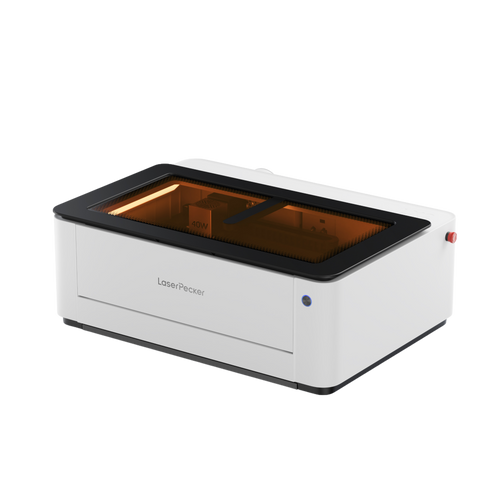
The LaserPecker LX2 is designed to make circular cutting fast, precise, and accessible.
1. High Speed
With cutting speeds of up to 1000 mm/s and rapid acceleration, projects can be completed efficiently without compromising accuracy.
2. Flexible Laser Modules
The LX2 allows you to switch between 20W, 40W, and 60W diode modules, as well as a 2W IR module. This flexibility makes it suitable for different wood thicknesses and additional materials beyond wood.
3. Precise Positioning
Built-in camera alignment and smart positioning tools help ensure that every circle is placed exactly where intended.
4. Large Work Area
The side-opening design accommodates larger boards and enables full-size circular cuts with ease.
With these things, the LaserPecker LX2 helps you cut great circles without much setup. It's good for beginners and pros.
Part 3: How to cut a circle in wood with LX2?
Here's how to get perfect circles with your LX2:

Step 1: Create your circle design
Start by drawing your circle in LightBurn, Illustrator, or any similar program. Check that your measurements are right and save the file in the correct format.
Step 2: Pick and set up your wood
Choose the kind of wood you want to use. Plywood, hardwood, and MDF are all good choices for the LaserPecker LX2. Keep your board flat and clamp it down. This keeps it from moving while the laser is working.
Step 3: Put the design into the LX2 software
Upload your design to the laser software. Use the built-in camera alignment system to position the circle precisely on the wood surface. This step is particularly important when working with limited material space or pre-cut boards.
Step 4: Set Up the Laser
Set the laser speed, power level, and number of passes according to the wood type and thickness.
If you are unsure about the correct parameters, perform a small test cut in an unused corner of the material. This helps fine-tune settings and minimise burn marks.
Step 5: Start Cutting
Begin the operation once alignment and settings are confirmed.
The LX2's focused beam and stable motion system allow it to cut smooth, accurate circles with minimal edge charring.
Step 6: Check and Sand
After cutting, remove the piece carefully and clean away any residue.
Light sanding may be applied if required, although most laser-cut edges need very little post-processing.
Part 4: FAQs about cutting a circle in wood
Q1. How to Cut Small Circles in Wood Without Special Tools
If you don't have advanced equipment, a hole saw attached to a hand drill is one of the simplest ways to cut small circles. For non-standard sizes, draw the circle carefully, cut along the line with a jigsaw, and smooth the edges using sandpaper or a file.
These methods are suitable for light DIY work. However, if you want cleaner edges and higher precision, using a laser cutter will provide more accurate and consistent results.
Q2. Can I Cut a Circle in Thick Wood?
Yes, but the best method depends on the thickness. CNC routers or routers fitted with circle jigs provide precise results for thick timber. A band saw is also effective for larger circles in solid wood.
Laser systems such as the LaserPecker LX2 can cut wood up to 22 mm in a single pass under optimal conditions. Compared to mechanical tools, lasers produce cleaner edges with greater repeatability.
Q3. How Do I Avoid Splintering When Cutting Circles?
Splintering occurs when cutting blades tear wood fibres during exit. To reduce this:
- Use a sharp, fine-tooth blade
- Apply masking tape along the cutting line
- Support the underside of the wood
- Maintain steady cutting speed
- Score the cut line before cutting
Laser cutting avoids splintering entirely because it uses a focused beam rather than physical contact, resulting in smooth, clean edges.
Q4. What Is the Easiest Way to Cut a Perfect Circle in Wood?
A laser cutter is the simplest and most accurate option. It follows your digital design exactly, eliminating the need for manual measuring or pivot setups.
For those without laser access, a router with a circle jig is a reliable alternative. While jigsaws and hole saws are accessible, they are more prone to inaccuracies.
Q5. Can a Laser Engraver Cut Thick Wood Like 10mm or 20mm?
Yes. High-powered diode systems such as the LaserPecker LX2 can cut 10 mm to 22 mm wood, depending on material type and settings. Thicker material may require slower speeds or multiple passes to maintain edge quality.
Although mechanical saws may cut faster in very thick timber, lasers offer superior precision and repeatability for detailed projects.
Q6. What Wood Types Work Best for Cutting Perfect Circles?
Plywood, MDF, basswood, and birch are commonly used for clean circular cuts. These materials have consistent density, which improves cutting accuracy.
Hardwoods such as oak or maple can also be used, but they may require slower cutting speeds or higher power settings.
Q7. Is Laser Cutting Safer Than Using Traditional Woodworking Tools?
Laser cutting reduces physical blade contact, lowering the risk of kickback or blade-related injuries. However, proper ventilation and eye protection are essential.
When operated correctly, laser systems offer a controlled and predictable cutting process compared to manual saws.
Conclusion
Cutting circles in wood can be achieved using a wide range of tools — from simple hand-held options like hole saws and jigsaws to more advanced equipment such as CNC routers and wood lathes. The right method depends on your required accuracy, material thickness, available tools, and experience level.
However, when it comes to achieving clean edges, accurate dimensions, and fully repeatable results, laser cutting stands out as the most precise and versatile solution. Its contact-free process eliminates splintering and reduces the need for post-processing, while digital control ensures consistency across every cut.
Using a laser cutter such as the the LaserPecker LX2 makes even complex circular designs easy to execute with minimal setup. Whether you're a hobbyist, DIY enthusiast, craft seller, or small workshop owner, laser cutting provides professional-quality results with efficiency and reliability.