










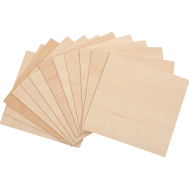
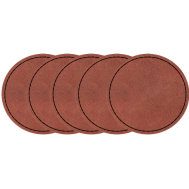
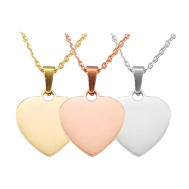
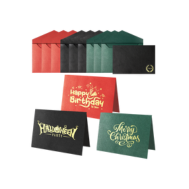





















MDF is widely used in the UK for furniture, cabinetry, signage, interior décor, and DIY woodworking projects. To cut MDF efficiently and achieve clean edges, makers typically rely on different types of MDF cutting machines and tools, ranging from basic handheld equipment to advanced laser cutters and CNC systems.
Each type of machine offers different advantages in terms of cutting precision, speed, cost, material thickness, and project flexibility. Some tools are better suited for simple straight cuts, while others are designed for detailed patterns, engraving, or batch production.
In this guide, we'll compare the most common MDF cutting machines, explain their pros and limitations, and explore why laser cutting machines are becoming one of the preferred options for precise and efficient MDF processing.

In this article:
- Part 1: Why Do People Need MDF Cutting Machines
- Part 2: 3 Types of MDF Cutting Machines
- Type 1: Manual Cutting Machines
- Type 2: Mechanical Cutting Machines
- Type 3: Laser Cutting Machines
- Part 3: Why Laser Cutters Are the Best MDF Cutting Machines
- FAQs: Common Questions about MDF Cutting Machines
Part 1: Why Do People Need MDF Cutting Machines?
MDF (Medium-Density Fibreboard) is widely used in the UK for furniture making, wall décor, cabinetry, signage, and DIY woodworking projects. Its smooth surface and consistent density make it ideal for precise cutting and finishing.
However, MDF can also be difficult to process using basic hand tools, especially for detailed or repeat production work. This is why many hobbyists, workshops, and professional makers choose dedicated MDF cutting machines.
Here are some of the main reasons why MDF cutting machines are commonly used:
Reason 1: High Precision
Projects such as furniture panels, shelving, and decorative wall pieces often require highly accurate cuts so that all components fit together properly.
Reason 2: Faster Production
Cutting MDF manually takes time and physical effort. Machine cutting significantly improves workflow efficiency, especially for batch production and repeat designs.
Reason 3: Consistent Results
For businesses and makers producing multiple identical parts, cutting machines help maintain uniform sizes, shapes, and cutting quality.
Reason 4: Cleaner Edges
Proper MDF cutting tools create smoother and cleaner edges, helping reduce chipping and minimising the amount of sanding required afterwards.
Reason 5: Detailed Designs
Complex patterns, engraved details, and intricate shapes are difficult to achieve consistently with manual tools alone. Advanced machines, particularly laser cutters, provide much greater precision for detailed work.
Using the right MDF cutting machine can greatly improve both production efficiency and finished quality for projects such as personalised signs, storage units, cabinets, speaker enclosures, and architectural models.
Part 2: 3 Types of MDF Cutting Machines
MDF can be processed using several different cutting methods, depending on the project size, production volume, and level of precision required. From handheld tools for DIY work to advanced laser systems for detailed production, each type of MDF cutting machine offers different advantages in terms of flexibility, accuracy, and efficiency.
Below are three of the most common types of MDF cutting machines and their typical applications.
Type 1: Manual Cutting Machines for MDF
Manual cutting machines are widely used in the UK for DIY woodworking, home improvement, and small workshop projects. These tools require hands-on operation and are generally more affordable than automated cutting systems.
Common manual MDF cutting tools include:
- Circular saws
- Jigsaws
- Handheld routers
With the correct blade setup and proper cutting technique, these tools can produce accurate cuts and relatively smooth edges on MDF boards.
However, manual cutting usually requires more experience and physical effort than automated systems. Maintaining perfectly consistent results across multiple pieces can also be difficult, especially for detailed patterns or decorative work.
Type 2: Mechanical Cutting Machines for MDF
Mechanical cutting machines use powered blades or rotating cutting heads to process MDF quickly and efficiently. These systems are commonly found in woodworking shops, furniture manufacturers, and professional production environments where higher output is required.
Typical mechanical MDF cutting machines include:
- CNC routers
- Table saws
- Panel saws
Compared with manual tools, these machines provide greater cutting speed, improved stability, and more consistent results.
Mechanical cutting systems are ideal for:
- Large MDF sheets
- Repeated production work
- Straight cuts and uniform dimensions
- Furniture and cabinet manufacturing
They are widely used for cabinetry, shelving systems, wall panels, and fitted furniture components throughout the UK market.
One important consideration is dust management. MDF produces a large amount of fine dust during cutting, so proper extraction systems and workshop ventilation are essential for maintaining a safer and cleaner working environment.
Type 3: Laser Cutting Machines for MDF
Laser cutting machines use a focused laser beam to cut or engrave MDF with extremely high precision. Unlike traditional cutting tools, laser systems do not rely on physical blades. Instead, the laser follows a digitally controlled path to burn through the material accurately and consistently.
Laser cutters are increasingly popular in the UK for:
- Decorative wall panels
- Personalised signs
- Scale models
- Craft products
- Custom MDF décor
Because the process is digitally controlled, laser machines can easily create intricate patterns, detailed engravings, and highly repeatable cuts.
For users in the UK, compact desktop laser cutters are particularly popular among home workshops and small creative businesses due to their space-saving design and ease of use.
Pros
High Precision
Laser cutters can produce extremely accurate cuts and fine engraved details, making them ideal for decorative and creative MDF projects.
Smooth Edges
The laser cuts cleanly through MDF, often leaving smooth edges with minimal finishing required.
Complex Designs
Laser systems can create detailed patterns and intricate shapes that are difficult to achieve with standard cutting tools.
Cutting and Engraving in One Machine
Many laser cutters can both engrave and cut MDF within the same workflow, improving efficiency and creative flexibility.
Excellent Repeatability
Digital control allows laser machines to reproduce identical pieces consistently, which is useful for batch production and custom orders.
Cons
Thickness Limitations
Some desktop laser cutters may struggle with very thick MDF boards compared with industrial CNC machines or panel saws.
Ventilation Requirements
Laser cutting MDF can generate smoke and odours, so proper air purification or extraction systems are recommended for indoor use.
Part 3: Why Laser Cutters Are the Best MDF Cutting Machines
Comparison of MDF Cutting Machines
| Method | Precision | Speed | Contact Cutting | Edge Quality | Complex Designs | Setup Cost |
|---|---|---|---|---|---|---|
| Manual Tools | Low–Medium | Low | Yes | Rough | Limited | Low |
| Mechanical Machines | Medium–High | High | Yes | Moderate | Good (CNC) | Medium–High |
| Laser Cutters | Very High | High | No | Clean & Sealed | Excellent | Medium |
When comparing different MDF cutting methods, laser cutters stand out because they combine high precision, fast processing speeds, and excellent flexibility for both creative and production work.
Reason 1: Extremely High Precision
Laser cutters follow digital design files with exceptional accuracy. This allows users to create fine lines, intricate patterns, and tightly fitting MDF parts with consistent quality.
For projects such as decorative wall panels, scale models, signage, and custom furniture components, this level of precision is extremely valuable.
Reason 2: Non-Contact Cutting Process
Unlike saw blades or router bits, laser cutters do not physically touch the MDF during processing. This non-contact cutting method helps reduce vibration and material stress during operation.
As a result, users often achieve:
- More accurate dimensions
- Cleaner cutting lines
- Reduced edge chipping
- Better consistency across repeated pieces
This is particularly useful for detailed decorative work and small production batches.
Reason 3: Clean and Sealed Edges
During cutting, the laser heat lightly seals the MDF edges. This helps minimise fibre splitting and can reduce the amount of sanding or finishing required afterwards.
Compared with many traditional cutting methods, laser-cut MDF often produces:
- Cleaner edges
- Smoother finishes
- Less surface damage
- Better visual quality for decorative projects
Reason 4: Cutting and Engraving in One Machine
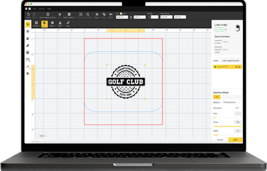
One major advantage of laser systems is that they can both cut and engrave MDF within the same workflow.
Users can easily add:
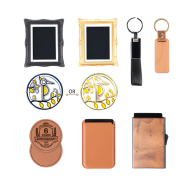
- Logos
- Decorative patterns
- Personalised text
- Product markings
- Detailed artwork
This improves production efficiency and simplifies custom project creation for workshops, Etsy sellers, and creative businesses across the UK.
Reason 5: Ideal for Custom and Small-Batch Production
With laser cutting, design changes only require updating the digital file. There is no need to replace blades or make complex mechanical adjustments.
This makes laser cutters highly suitable for:
- Small workshops
- Design studios
- Home businesses
- Prototype production
- Small-batch manufacturing
For UK users who regularly produce customised MDF products, laser cutting offers both flexibility and repeatable accuracy.
Typical Laser Power for MDF Laser Cutting
Actual settings may vary depending on machine configuration, airflow, and MDF quality.
| MDF Thickness | Recommended Power | Cutting Approach |
|---|---|---|
| 3 mm | 20W diode laser | Single pass, high speed |
| 6 mm | 40W diode laser | Single pass or slower cutting |
| 9–12 mm | 40W–60W diode laser | Multiple passes recommended |
Using extremely high power in a single pass may sometimes create darker edges or carbon residue. In many cases, lower power combined with multiple passes produces cleaner results and improves edge quality.
Multi-pass cutting also gives users greater control over cutting depth and heat management, helping reduce burning during detailed MDF projects.
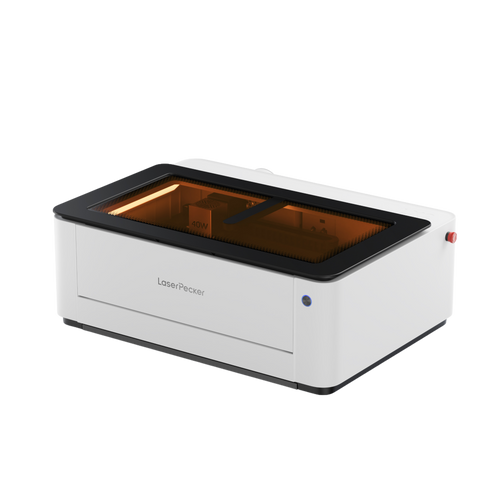
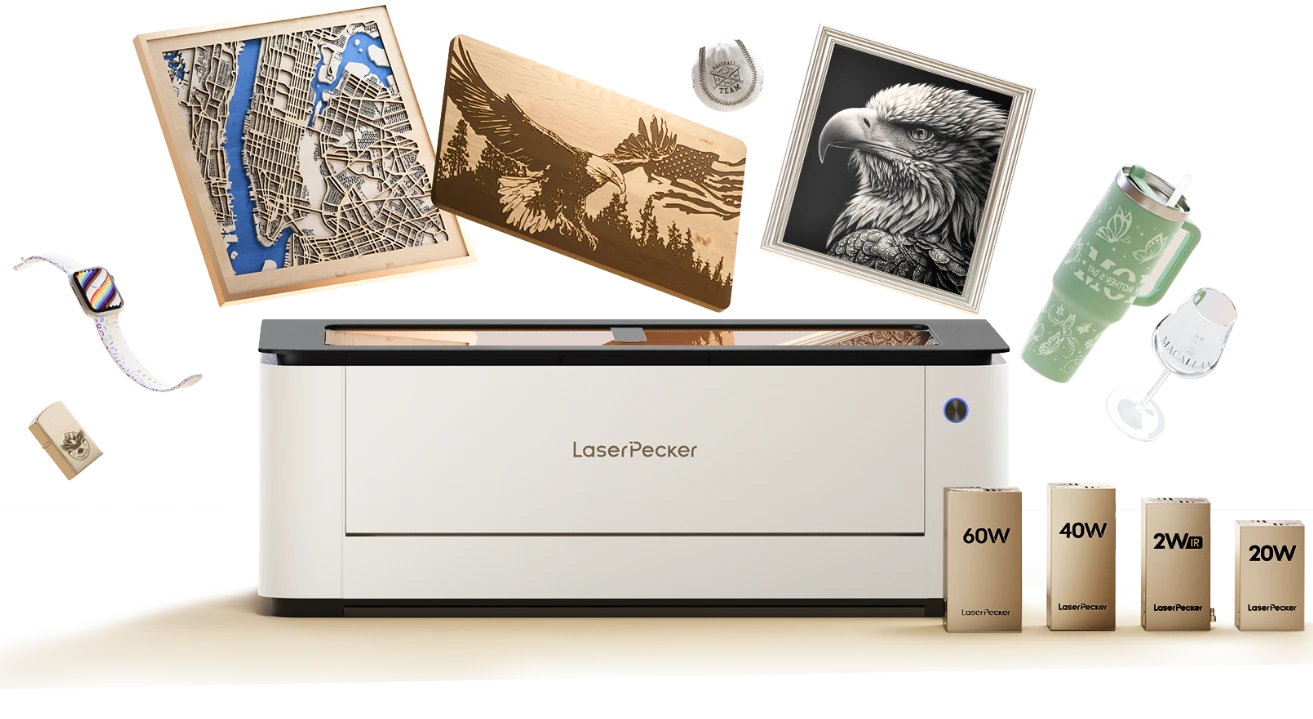
Recommended MDF Laser Cutter: LaserPecker LX2
If you need a desktop laser cutter for detailed MDF cutting and engraving, the LaserPecker LX2 is a practical option for workshops, creative studios, and small-scale production environments.
For users in the UK, the LX2 is especially attractive because of its enclosed Class 1 Laser Safety design, making it more suitable for indoor workshop and studio use.
The machine can also be paired with the LaserPecker Desktop Smoke Purifier, which helps filter smoke, odours, and airborne particles generated during MDF engraving and cutting. This creates a cleaner and safer indoor working environment.
Feature 1: Large Working Area
The spacious working area allows users to process larger MDF sheets, decorative panels, and custom signage more efficiently.
Feature 2: Interchangeable Laser Modules (20W / 40W / 60W)
Users can select different laser power modules depending on MDF thickness and project requirements, providing greater flexibility for various cutting tasks.
Feature 3: High Motion Precision
The precision motion system helps ensure highly accurate cutting paths, which is particularly important for interlocking parts and detailed decorative work.
Feature 4: Built-in Camera Assistance
The integrated camera system improves material positioning and design alignment before cutting, helping reduce setup errors.
Feature 5: Adjustable Focus
The adjustable focus system helps maintain optimal cutting performance across different MDF thicknesses and material types.
FAQs: Common Questions about MDF Cutting Machines
Q1. How Many Teeth Should a Blade Have for Cutting MDF?
For a standard 250 mm (10-inch) table saw blade, a blade with around 60–80 teeth is usually recommended for MDF cutting. Higher tooth counts produce smoother edges and help reduce chipping. While lower tooth count blades cut faster, they often leave rougher finishes.
Q2. What Is the Best Saw Blade for Cutting MDF?
A carbide-tipped blade with a high tooth count is generally considered the best option for MDF. MDF contains resin and compressed wood fibres, which can wear standard blades quickly. Carbide blades remain sharper for longer and provide cleaner cuts.
Blades designed for laminate or plywood cutting also perform well on MDF boards.
Q3. Is MDF Easy to Cut?
Yes, MDF is generally easier to cut than many natural wood materials because it has no grain direction.
However, MDF creates a large amount of fine dust during cutting, so proper extraction systems and protective equipment are highly recommended.
Q4. Can Laser Cutters Cut Thick MDF Boards?
Yes, many laser cutters can process thicker MDF materials, but cutting capability depends on laser power and machine configuration.
For example:
- 20W lasers are suitable for thinner MDF sheets
- 40W–60W lasers are better for thicker boards
- Multiple cutting passes often improve edge quality on thick MDF
For cleaner indoor operation, many UK users pair desktop laser cutters with smoke purification systems to help reduce fumes and odours during MDF processing.
Conclusion
MDF remains one of the most widely used materials for woodworking, DIY projects, interior décor, and custom fabrication across the UK. While traditional tools such as table saws, routers, and CNC machines are still effective for many applications, modern laser cutters offer greater precision, cleaner finishes, and significantly more design flexibility.
For hobbyists, professional makers, creative studios, and small workshops that require intricate patterns, smooth edges, and repeatable cutting quality, laser cutting machines such as the LaserPecker LX2 provide an excellent balance of speed, accuracy, and workflow efficiency.